"How Is This Okay?": Union Busting at Publicly Funded Facilities Amid Staffing Crisis

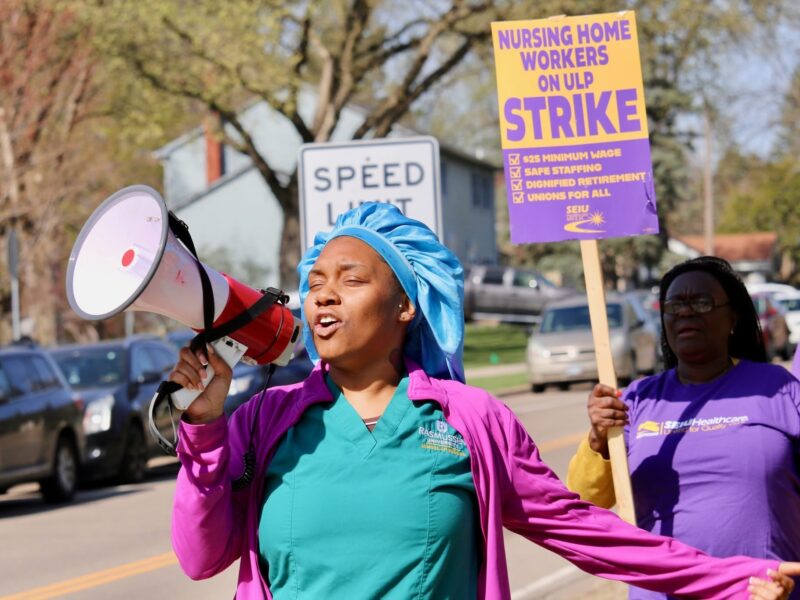
A report published in March by Columbia University’s Labor Lab finds that nursing homes in Minnesota that receive public funds through Medicare and Medicaid are more likely to use union-busting tactics, including pressure, surveillance, and discipline. The report draws from data and surveys collected over four years, and states, “We find that workers are more likely to report union avoidance tactics in facilities with larger shares of resident care financed by public funds.” 

The report focuses on four Minnesota nursing homes, including one facility that is publicly owned, one for-profit facility within a larger healthcare system, one for-profit company run by a private equity chain, and one faith-based nonprofit. All four facilities were found to have engaged in union-busting tactics, including anti-union flyering, verbal pressuring of workers, and even asking residents and their families to participate in anti-union pressure. The report states that about “50% of the revenue of these companies comes from public programs like Medicare and Medicaid” and thus, “Minnesota taxpayers may be subsidizing the union avoidance activities of private employers.”

The researchers conducted interviews with workers “across a range of facilities” and found that union-busting occurs preemptively, with many workers exhibiting fear before having met with an organizer, and found that this pattern across workplaces in the industry “undermines workers’ freedom of association well before the beginning of a union drive.” The report highlights specific instances where nursing home workers from immigrant backgrounds and Black workers display fear of employer retaliation for unionization. 

The report also surveyed 1,991 registered certified nursing assistants (CNA) in Minnesota, asking workers for their place of work, their assessment of unions in their workplace, and if they witnessed union-busting tactics such as employer-organized meetings and the distribution of anti-union materials. The report then states, “We find a strong, positive, and significant association between respondents’ reports of anti-union activity within a facility and that facility’s reliance on public money.” 

Further, the report found that nursing home facilities “most dependent on public resources are also those in which conditions are worse for both residents and workers, and those in which workers face the most aggressive management opposition when they try to join together to push management to improve conditions.” 

The findings provoked outrage among nursing home workers, concerned about public funds being used to finance anti-union tactics.

How Labor Can Fight Back Against Trump’s Mass Deportation Agenda

This article is a joint publication of Workday Magazine and Labor Notes. This is a frightening time for immigrant workers. President-elect Donald Trump ran on the slogan “mass deportations now,” and has appointed a team of anti-immigrant hardliners. The leadership of the Democratic Party has lurched to the right on this issue, adopting Trump’s rhetoric about “securing the border,” and embracing core Republican policies. 

A bill that would target undocumented people for deportations if they are merely accused—not convicted—of nonviolent crimes like shoplifting passed in the House with bipartisan support. It’s moving forward in the Senate where only eight Democrats opposed its advance.

The 90th Anniversary of the 1934 Truckers’ Strike Honors Minneapolis’ Militant Labor History [VIDEO]

Descendants Honor 90th Anniversary of Ancestors’ Militant Labor Strike from Unicorn Riot on Vimeo.This video was produced in collaboration with Unicorn Riot and Workday Magazine. On July 27, workers, descendants of the strikers, and the local labor community came together at Wabun Park in Minneapolis to honor the 90th anniversary of the 1934 Truckers’ Strike that brought Minneapolis to a standstill and served as a spark for radical and militant labor struggle across the country. 

The strike lasted about three months, as Teamsters Local 574 truckers demanded a fair wage and official recognition of the union. The trucking companies had the support of the Citizens Alliance, an anti-trade union organization that sought to break the strike. The strike’s impact reverberated throughout the city, bringing much of the Minneapolis economy to a halt. 

After reaching an agreement, the trucking companies did not honor the terms and workers returned to the streets. On July 20, 1934, the Minneapolis police attacked and opened fire on picketers in the streets of the Warehouse District.

Master Lock Factory in Milwaukee Closes After 100 Years

After more than 100 years, Master Lock’s iconic factory in Milwaukee is shutting its doors in March 2024. The closure will result in 400 lost union jobs, and also mark the end of a former industrial region of the city that once housed some 50 plants. https://www.youtube.com/watch?v=VfmKb2dvimU

The Real News, In These Times, and Workday Magazine speak with current and former Master Lock workers on what the closure of this longstanding plant means for them and their community. Transcript

The following is a transcript of the video

President Obama:

Hello, Milwaukee. That’s what we’ve got to be shooting for is to create opportunities for hardworking Americans to get in there and start making stuff again and sending it all over the world, products stamped with three proud words, “Made in America.” That’s what’s happening right here at Master Lock.

The U.S. Labor Voices Opposing Military Aid to Israel

This article was jointly produced by Workday Magazine and In These Times. As the Israeli military relentlessly bombards 2.4 million Palestinians in the besieged Gaza Strip and a ground invasion appears imminent, one storied, national union — the United Electrical, Radio and Machine Workers of America (UE) — is opposing U.S. military aid for the state of Israel whose assault on the besieged strip has already taken the lives of at least 1,800 Palestinians (a number that is quickly rising) and displaced more than 420,000 others. The Israeli government’s overwhelming violence comes on the heels of a surprise attack by Hamas militants on October 7 when 150 were taken hostage and more than 1,300 people, almost entirely Israelis, were killed. “We certainly don’t support any killing, whether it’s in the form of bombs, guns, starving people through blockades, or through apartheid, from any side,” says Andrew Dinkelaker, the UE’s general secretary treasurer. ​“U.S. military aid going in is pouring gasoline onto a fire. It encourages that there be military solutions, and military solutions will get more people killed.”

In opposing U.S. military aid to Israel, the UE — along with some organizers, elected representatives and rank-and-file workers from other unions, as well as just a few progressive members of Congress like Rep. Rashida Tlaib (D.-Mich.) and Rep. Cori Bush (D.-Mo.) — is striking in a U.S. political climate defined by unqualified bipartisan support for Israel’s newly formed, hawkish ​“unity” government as it uses white phosphorus and cuts off fuel, food, water and electricity to Gaza’s entire population, which is about half children. 

A video has been circulating of Israel’s Defense Minister Yoav Gallant saying, ​“We are fighting against human animals.” Israeli President Isaac Herzog said Friday, ​“It’s an entire nation out there that is responsible.