


Minneapolis residents who have been raising funds for neighbors who have been unable to work due to Operation Metro Surge are urging city leaders to take action to prevent an eviction crisis.
Subscribe
Minnesota

One Grocery Worker's Fight to Defend What Matters Most
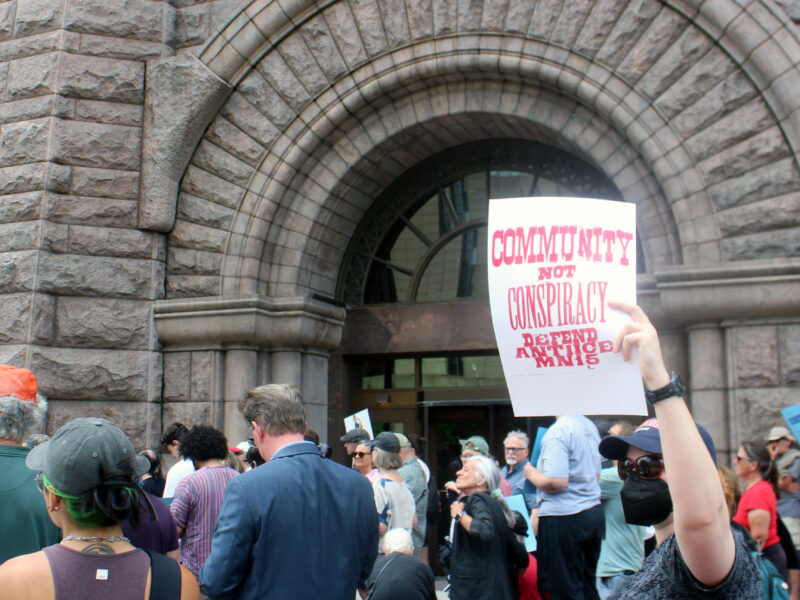
“An Attack on All of Us”: Labor Rallies at Courthouse for the Minnesota 15

Minnesota Trade Unionists Among Those Targeted in Federal Indictments of ICE Observers

Sex Workers Dance in the Streets of Minneapolis and Reflect on the Impact of Operation Metro Surge
Media

“How Is This Okay?”: Union Busting at Publicly Funded Facilities Amid Staffing Crisis
A report published in March by Columbia University’s Labor Lab finds that nursing homes in Minnesota that receive public funds through Medicare and Medicaid are more likely to use union-busting tactics, including pressure, surveillance, and discipline. The report draws from data and surveys collected over four years, and states, “We find that workers are more likely to report union avoidance tactics in facilities with larger shares of resident care financed by public funds.”
The report focuses on four Minnesota nursing homes, including one facility that is publicly owned, one for-profit facility within a larger healthcare system, one for-profit company run by a private equity chain, and one faith-based nonprofit. All four facilities were found to have engaged in union-busting tactics, including anti-union flyering, verbal pressuring of workers, and even asking residents and their families to participate in anti-union pressure. The report states that about “50% of the revenue of these companies comes from public programs like Medicare and Medicaid” and thus, “Minnesota taxpayers may be subsidizing the union avoidance activities of private employers.”
The researchers conducted interviews with workers “across a range of facilities” and found that union-busting occurs preemptively, with many workers exhibiting fear before having met with an organizer, and found that this pattern across workplaces in the industry “undermines workers’ freedom of association well before the beginning of a union drive.” The report highlights specific instances where nursing home workers from immigrant backgrounds and Black workers display fear of employer retaliation for unionization.
The report also surveyed 1,991 registered certified nursing assistants (CNA) in Minnesota, asking workers for their place of work, their assessment of unions in their workplace, and if they witnessed union-busting tactics such as employer-organized meetings and the distribution of anti-union materials. The report then states, “We find a strong, positive, and significant association between respondents’ reports of anti-union activity within a facility and that facility’s reliance on public money.”
Further, the report found that nursing home facilities “most dependent on public resources are also those in which conditions are worse for both residents and workers, and those in which workers face the most aggressive management opposition when they try to join together to push management to improve conditions.”
The findings provoked outrage among nursing home workers, concerned about public funds being used to finance anti-union tactics.
Minnesota
“Bigger Than a Contract”: In the Twin Cities, Marches, Strikes, and Blockades for May Day
Workers across the Twin Cities rallied and marched on International Worker’s Day, or May Day, in solidarity with contract fights, to stand with immigrant workers, and to oppose the threats against working people all over the globe.
Many of the actions were led by leaders in the ICE OUT coalition that formed following Operation Metro Surge earlier this year. From the early morning hours into the evening of May 1, workers went out on strike, picketed in front of businesses, and led rallies in Minneapolis and St. Paul. Along with specific demands of various contract fights, the coalition is also calling for ICE to discontinue operations in Minnesota, that any officer who kills a civilian be held legally accountable, no additional federal funding for ICE in the upcoming congressional budget, and an investigation for human rights and constitutional violations committed by ICE. The coalition is also demanding corporations become 4th Amendment businesses, ceasing economic relations with ICE and refusing ICE entry or use of their property.
Minnesota

Why Target is at the Center of an ICE-Out Campaign in Minnesota
ICE Out of MN, a coalition of unions, worker centers, and community organizations, is putting pressure on Minnesota’s corporations that stayed silent as thousands of federal immigration agents wreaked havoc on the state.The coalition is focusing its efforts on Target, a “home-grown” corporation, that once proudly championed progressive causes and local philanthropy, and has since rolled those commitments back, and donated $1 million to President Trump’s 2025 inauguration.
The coalition is leading a corporate pressure campaign to urge the company to take steps to protect workers and use its political and economic capital to lobby against ICE. While ICE activity has decreased since its peak in Minnesota, detentions continue, and organizers are outraged that Target has stayed silent, even as ICE has come on its property. In January, two Target workers were violently detained while on the job at a Richfield, Minn., location. The workers were both U.S. citizens.
Target, along with over 60 CEOs and other corporate leaders in Minnesota, published a brief letter on the Minnesota Chamber of Commerce website, asking for “de-escalation” the day after the killing of Alex Pretti by federal agents in Minneapolis. Organizers from the ICE Out of MN coalition argue that the letter is insufficient and does not directly ask for the end of ICE activity in the state. Workday Magazine reached out to Target for comment and did not receive a response by the deadline.
Minnesota

Terrorized By ICE, Unable to Pay Rent, Minnesotans Are Getting Ready for a Rent Strike
This article is a joint publication of Workday Magazine and In These Times. First, she started checking for suspicious cars each day before leaving the house for work. Then, she began skipping work whenever she saw Facebook posts about Immigration and Customs Enforcement (ICE) agents nearby. By the end of December, she wasn’t working at all. And since the first week of January, Anain, who declined to use her last name, has barely left the home she shares with her spouse and two young daughters in South Minneapolis, the neighborhood where she’s lived for more than 20 years.
To pay their rent, Anain and her spouse have had to dip into their savings.
Minnesota

Waiters, Cooks, and Bartenders Are Calling on Hospitality Industry to Ban ICE From Minnesota Restaurants
On February 13, restaurant workers rallied outside the Hospitality Minnesota building in downtown Minneapolis to deliver a Valentine’s Day card asking industry leaders to ban ICE from restaurants. The workers also want stronger protocols for protections at restaurants, and know-your-rights trainings for restaurant workers on the front lines. It’s not radical to refuse service to agents who are threatening and at times killing our community members,” said Jake, a line cook at prominent Minneapolis restaurants. The rally was organized by the “86 ICE” coalition, supported by Restaurant Opportunities Center of Minnesota (ROC MN and Centro de Trabajadores Unidos en la Lucha (CTUL), which includes both front- and back-of-house restaurant workers and restaurant owners. The number “86” refers to restaurant and bar patrons who are kicked out of an establishment.
Minnesota

Worker Organizer Abducted By Federal Agents in Minnesota
This article is a joint publication of Workday Magazine and In These Times. Federal immigration agents have abducted Eustaquio Orozco Verdusco, a workers’ rights organizer well known in Minnesota for fighting wage theft and labor trafficking.
His attorney and son say he is currently held at the Cibola County Correctional Center in New Mexico, run by CoreCivic, one of the largest private prison companies in the United States. For the first time, his family is going to the press as community support for his release is swelling. “All we care about is having him back with us, at home in Minnesota,” his son, Gerardo Orozco Guzman, told me. “That’s all we want.”
Our interview followed a judge’s ruling in the District Court of Minnesota on Wednesday that denied and dismissed Orozco Verdusco’s habeas corpus petition challenging his unlawful detention.
Minnesota

The Minnesota Target Workers Who Walked Out Against ICE
This article is a joint publication of Workday Magazine and The American Prospect. Rob doesn’t want anyone else to experience what his co-workers at the Target store in the Minneapolis suburb of Richfield went through. On January 8, federal immigration agents violently tackled and detained two Target workers during their shift. Rob was on the clock that day, and while he did not see the abductions, he did witness the aftermath. “We had a lot of people who were scared,” says Rob, who is using a pseudonym to protect him from retaliation.
Minnesota

Poll Shows Massive Participation in Minnesota Shutdown Against ICE
This article is a joint publication of Workday Magazine and In These Times. Roughly one in four Minnesota voters either participated in the January 23 day of shutdown and protest against ICE, or have a loved one who did, according to new polling data.
Of those participants, 38% percent stayed off the job, either because they did not go to work, or because their employer closed for the day of action. The data does not distinguish between those who made the choice to stay out, and those who saw their workplaces close. (Some workplaces were shuttered that day due to worker pressure.)
The poll was commissioned by the May Day Strong coalition, a network of local and national unions and community organizations, and was conducted by polling firm Blue Rose Research. McKenzie Wilson, director of external affairs and message strategy at the firm, explained that researchers surveyed 1,940 Minnesotans who voted in 2024.
Minnesota

Alex Pretti’s Killer May Be Part of His Union
This article is a joint publication of Workday Magazine and Jewish Currents. On January 24th, Border Patrol agents shot and killed Veterans Affairs ICU nurse and ICE observer Alex Pretti in Minneapolis—firing at least 10 shots within five seconds while Pretti was pinned to the ground. About six hours later, Pretti’s labor union, the American Federation of Government Employees (AFGE), released a statement about his murder. “We have received confirmation that a member of AFGE Local 3669, Alex J. Pretti, was the man killed during the incident,” it read. But while referring to Pretti’s killing as a “tragedy,” the statement fell short of condemning the federal immigration agents behind the shooting.
Minnesota

“Everybody Showed Up”: Stunning Crowds at Minnesota Day of Strike and Shutdown Against ICE
Some 100 faith leaders are braving freezing temperatures to block a key road outside of the Minneapolis–St. Paul Airport to protest ICE.