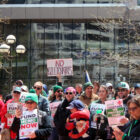
WHITING, IND.—Six and a half months after being locked out of his job as a British Petroleum (BP) operator, Jon is still showing up to picket shifts. I met him on the side of a road, the refinery spewing smoke behind him. For a while, unemployment benefits of around $335 a week helped ease the financial burden, he tells me, but those went away at the end of September when he hit the six-month mark. And now, BP is appealing the locked-out workers’ unemployment with the state of Indiana. It’s a move that could result in workers like Jon having to pay back the assistance they’ve already received.
This article is a joint publication of Workday Magazine and The American Prospect. WHITING, INDIANA—Elizabeth Piña has been at her union hall since 4:00 a.m., checking in picketers, organizing the food pantry, and chatting with her coworkers. She is wearing a black t-shirt, and sitting behind a table filled with schedules and stickers that say “end the lockout.”. She hasn’t “had much of a summer,” she tells me; it’s been dominated by the early-morning shift, Monday through Friday. When I ask her if she is tired, she says, “Nope.
A report published in March by Columbia University’s Labor Lab finds that nursing homes in Minnesota that receive public funds through Medicare and Medicaid are more likely to use union-busting tactics, including pressure, surveillance, and discipline. The report draws from data and surveys collected over four years, and states, “We find that workers are more likely to report union avoidance tactics in facilities with larger shares of resident care financed by public funds.”
The report focuses on four Minnesota nursing homes, including one facility that is publicly owned, one for-profit facility within a larger healthcare system, one for-profit company run by a private equity chain, and one faith-based nonprofit. All four facilities were found to have engaged in union-busting tactics, including anti-union flyering, verbal pressuring of workers, and even asking residents and their families to participate in anti-union pressure. The report states that about “50% of the revenue of these companies comes from public programs like Medicare and Medicaid” and thus, “Minnesota taxpayers may be subsidizing the union avoidance activities of private employers.”
The researchers conducted interviews with workers “across a range of facilities” and found that union-busting occurs preemptively, with many workers exhibiting fear before having met with an organizer, and found that this pattern across workplaces in the industry “undermines workers’ freedom of association well before the beginning of a union drive.” The report highlights specific instances where nursing home workers from immigrant backgrounds and Black workers display fear of employer retaliation for unionization.
The report also surveyed 1,991 registered certified nursing assistants (CNA) in Minnesota, asking workers for their place of work, their assessment of unions in their workplace, and if they witnessed union-busting tactics such as employer-organized meetings and the distribution of anti-union materials. The report then states, “We find a strong, positive, and significant association between respondents’ reports of anti-union activity within a facility and that facility’s reliance on public money.”
Further, the report found that nursing home facilities “most dependent on public resources are also those in which conditions are worse for both residents and workers, and those in which workers face the most aggressive management opposition when they try to join together to push management to improve conditions.”
The findings provoked outrage among nursing home workers, concerned about public funds being used to finance anti-union tactics.
Workers across the Twin Cities rallied and marched on International Worker’s Day, or May Day, in solidarity with contract fights, to stand with immigrant workers, and to oppose the threats against working people all over the globe.
Many of the actions were led by leaders in the ICE OUT coalition that formed following Operation Metro Surge earlier this year. From the early morning hours into the evening of May 1, workers went out on strike, picketed in front of businesses, and led rallies in Minneapolis and St. Paul. Along with specific demands of various contract fights, the coalition is also calling for ICE to discontinue operations in Minnesota, that any officer who kills a civilian be held legally accountable, no additional federal funding for ICE in the upcoming congressional budget, and an investigation for human rights and constitutional violations committed by ICE. The coalition is also demanding corporations become 4th Amendment businesses, ceasing economic relations with ICE and refusing ICE entry or use of their property.
Minneapolis residents who have been raising funds for neighbors who have been unable to work due to Operation Metro Surge are urging city leaders to take action to prevent an eviction crisis.
Este artículo también está disponible en inglés. Traducción de María Uhlmann
Dina Velasquez Escalante trabaja en una planta avícola en el sudoeste de Minnesota. Su día de trabajo consiste en inspeccionar el pollo que millones de estadounidenses consumen a diario. Lo que busca son tumores, huesos y órganos, además de retirar la bilis. Luego de 6 años de trabajo intenso, y de adquirir experiencia en casi todos los puestos de la línea de producción, ahora se encuentra en el laboratorio analizando muestras de pollo para asegurar la mejor calidad.